First Through the Door: How Megan Chavez Went From Code Platoon's Inaugural Cohort to the Phoenix Suns

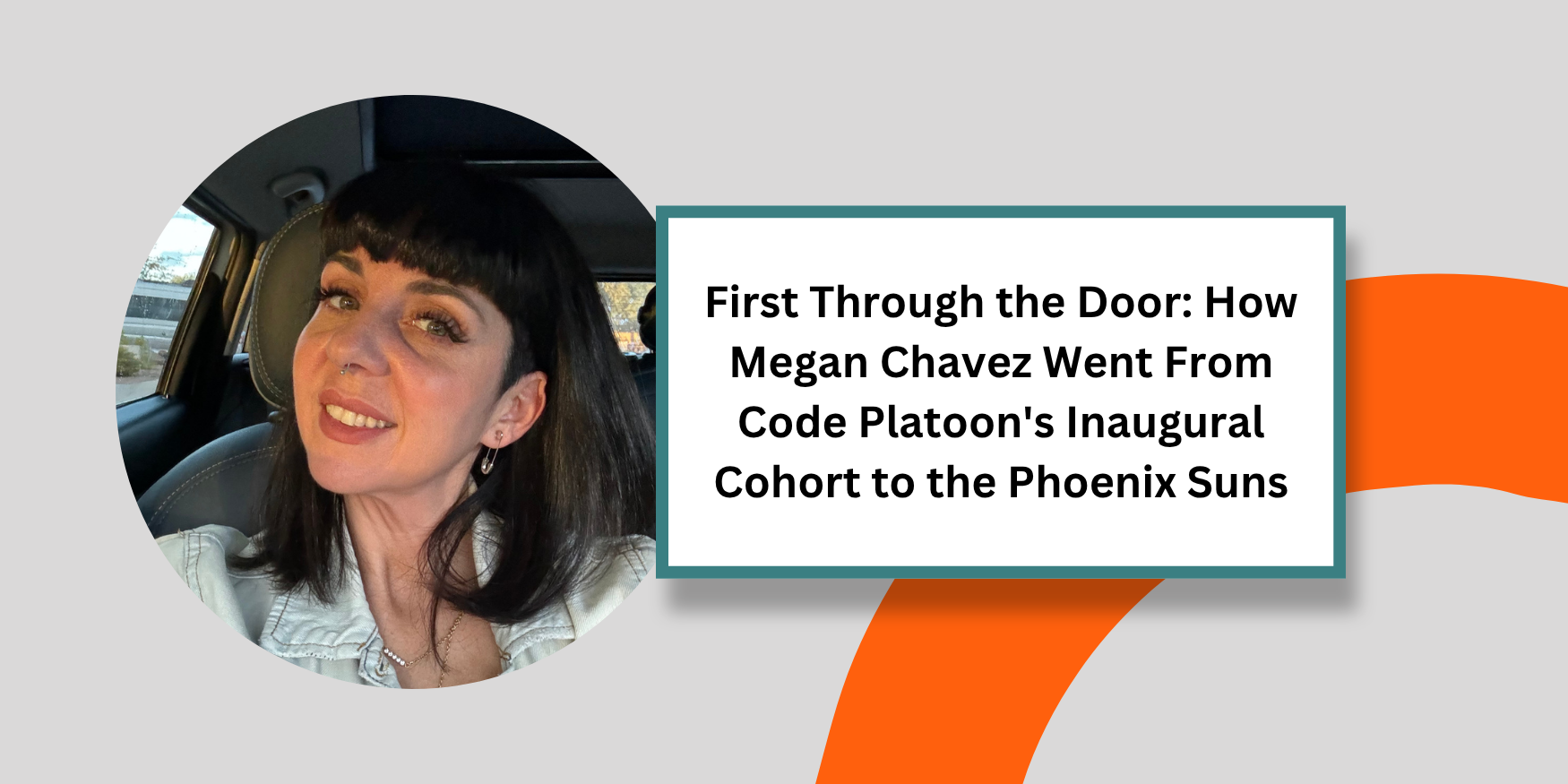
Megan Chavez is the Director of Web for the Phoenix Suns. She got there by way of the Air Force, a nearly finished degree in classical studies, a Reddit post she wasn't even the target of, and the very first cohort Code Platoon ever ran. If that path looks improbable on paper, that's because it was — and Megan navigated every turn of it.
Before any of it, she flew. Megan served in the Air Force as aircrew, active duty through 2009 and then in the reserves — the real kind, not the brochure kind. "If you fly on planes, it's like, Thursday, sorry about your regular job," she says of a schedule that ran daily missions rather than one weekend a month. When she started looking at what came next, she was two classes shy of a bachelor's in classical studies, with a minor in bioinformatics — modeling how ancient populations grew and how disease moved through them, in Latin and ancient Greek.
It was fascinating. It was also, by her own clear-eyed accounting, a dead end for what she wanted. "I'm trying to get on a ship that's on fire and sinking at the same time," she says of the idea of chasing a tenured professorship in the classics. "Telling people I majored in Latin is the least exciting thing I can say when I'm trying to make money." So she made a hard, deliberate call: she left the degree on the table and bet on something else entirely.
The something else found her by accident. Scrolling Reddit — a veterans forum, or maybe a Chicago one, she can't remember which — she came across a job posting for a Code Platoon instructor. She wasn't an instructor. But she read on, saw that student applications were about to open, and waited. "I definitely didn't find out about it the way they intended," she says. There was no marketing funnel that reached her. She reached it.
The application was a full one — tell us about yourself, tell us about your service — plus a video on why she wanted in. Megan roped her kids into the video compilation. ("I don't think they made the final cut," she notes.) She was accepted into Alpha: the first cohort Code Platoon ever ran, a tiny pilot group learning in person, Monday through Friday, in a borrowed room at Roosevelt University on South Michigan, across from the Art Institute.
It was scrappy. There was one core instructor, a handful of one-day guest sessions for things like HTML and JavaScript, Ruby on Rails as the language of the day, and a founder, Rod, who was in the room constantly. Megan — who cheerfully describes herself as suspicious by nature — spent the early weeks waiting for the catch. "I was like, why does this guy who never served in the military give two shits about where our careers are going?" she says. "That's on me. I'm a negative person." By the end, the question had answered itself. "There was never a question as to why. He was so nice, so hands-on, so involved."
Here's the part she wants people to understand: the messiness wasn't a flaw she endured.
It was the fit. "In all honesty, I don't think I would have made it if it was all buttoned up," she says. "It made more sense for me to be on the messy version of it. If the program had been super polished and professional, it wouldn't have been appealing to me — it wouldn't be appealing to me now." Alpha didn't need a screener or a coding challenge or a two-part funnel. It needed people willing to walk through an unmarked door first. Megan was one of them.
At the time, she was mildly annoyed that a program she'd joined to learn to code kept spending days on resumes and project management and how to explain technical work to non-technical people. A decade of hindsight flipped that completely.
"Now I think those two days learning to write resumes were more valuable than two days learning to code," she says. "Code is malleable. It changes. Ruby on Rails is where I cut my teeth, and you haven't heard anyone mention it in years. The code is going to look different from job to job. But I don't change. Fundamentally, I need the people skills and the mechanisms to pull the triggers to get where I need to go." Her internship out of the program was in JavaScript — a language she took one look at and thought made no sense. She has now built with it for eleven years straight. The specific language never mattered. The durable skills underneath it did.
And she has needed every one of them, because what came next was a genuine odyssey.
Megan turned her internship at Noggin Labs into a full-time role and stayed about two years. From there she became Rush Street Gaming's go-to developer, then helped stand up a Chicago tech hub for the agricultural-seed giant Syngenta — "very Chicago, all we do is grain and food," she says. She tried project management and discovered, definitively, that she hated it. When her employer demanded everyone return to the office in the thick of COVID with her kids at home, she walked out on a Tuesday and took a job at Starbucks for the health insurance, because being present for her children mattered more than the title. ("My kids said it was the best job I've ever had," she laughs — she brought home the pastries.)
Then the pattern that had been forming all along came into focus. Tired of being handed sales deals no one had bothered to check were buildable, she complained her way into a role she didn't know existed: sales engineering. It turned out to be exactly her — the person who sits between the code and the customer, who can read a system from twenty thousand feet and translate it for people who don't speak the language. She built out a sales-engineering department from scratch, spent four years at it, moved to the enterprise CMS company Sitecore, and then got the call that ended with a question she couldn't refuse: did she want to run web for all the Phoenix basketball properties?
"How could you say no?" she says. These days she brings her kids to Mercury games and walks her seventeen-year-old down to sit on the floor. "They put their phones down for a minute," she says — which, for a teenager, is its own kind of trophy.
Ask her whether Code Platoon still matters ten years and a dozen reinventions later, and she doesn't hedge. "I wouldn't have a leg to stand on if it weren't for Code Platoon," she says. It was the foundation, plus the program's Chicago relationships that opened the internship door, plus a peer network that has quietly held for a decade. "I still know where the people I went to class with work. If someone gets laid off, we reach out, we vouch for each other. We know each other's whole history just from observation. I really do think it's the only reason I'm where I am today."
There's one more thing the first cohort gave her, and it's the thing she names last, almost in passing, as the truest. That chaotic, held-together-with-tape pilot program turned out to be perfect preparation for the actual working world — because the working world, she learned, is exactly that chaotic. "I went to an enterprise company thinking they'd have everything together, streamlined, process control," she says. "No. They suck too. Everybody's flying by the seat of their pants hoping it works — Adobe or Joe's startup, doesn't matter. Code Platoon brought that to light. As messy as that first cohort was, it prepared us for a world that's just as messy."
Megan Chavez walked through Code Platoon's door before there was a clear path on the other side of it. She's been carving her own ever since — and it led all the way to the front row.
.png?width=352&name=Pay-What-You-Can%20Scholarship%20Blog%20(1).png)